
If a high-severity vulnerability were found in one of your software dependencies right now, how long would it take your team to identify the affected applications? Would it be minutes, hours or days?
For many firms, the answer can reveal uncomfortable truths about SBOM programs. Even though many people use SBOM Management tool, mistakes keep delaying impact analysis and fixing. In 2026, these mistakes will have bigger consequences than ever before.
The problem isn’t lack of tooling or awareness. It is execution. As SBOM programs grow, small mistakes add up to structural weaknesses that reduce visibility, delay responses to vulnerabilities and erode trust SBOM data. These problems don’t usually happen overnight, they happen gradually as software ecosystems become more complex.
It’s important to understand the most common SBOM mistakes to avoid stagnation and making sure your SBOM programs stay useful in 2026 and beyond.
1. Treating SBOMs as Static Compliance Artifacts
One of the most common SBOM mistakes is treating them as documentation instead of operational assets.
Many organisations still:
- Generate SBOMs only for audits or customer requests
- Store SBOM files without analysing them
- View SBOM creation as a one-time task
This method gives people false confidence in 2026. Static SBOMs quickly become outdated during real vulnerability events because dependencies change. SBOMs must be living artifacts with constant development and deployment.
2. Failing to Capture Complete Dependency Trees
A big challenge is incomplete visibility.
A critical mistake is only focusing on direct dependencies and ignoring the transitive ones. Modern applications depend on deeply nested libraries that often introduce the highest risk.
Some common causes are:
- Limited tooling coverage
- Inconsistent build environments
- Manual SBOM generation
- Poor validation processes
When dependency trees are incomplete, vulnerability impact assessments become inaccurate and remedy efforts are misdirected.
3. Not Keeping SBOMs Aligned with Runtime Reality
What gets built doesn’t always work.
One of the most damaging SBOM mistakes firms make with SBOMs is to assume that build-time SBOMs always show runtime environments. In fact, runtime behaviour can change because of:
- Conditional dependencies
- Dynamic loading
- Environment-specific configurations
- Container and image drift
In 2026, security teams increasingly rely on quick and accurate exposure assessments. SBOMs that do not align with runtime reality force teams to fall back to doing manual investigations during critical incidents.
4. Ignoring Integration with Vulnerability Management Workflows
This is another common mistake that firms make. Treating SBOMs as separate from incident response and vulnerability management processes. This leads to:
- Manual correlation during vulnerability disclosures
- Delayed remediation decisions
- Over-patching low-risk components
- Missed prioritisation opportunities
Without integration, SBOMs are just passive inventories rather than active security tools.
5. Lacking Clear Ownership and Governance
SBOM projects often fail because of unclear accountability.
One of the most overlooked mistakes people make with SBOMs is assuming that “everyone” owns them. In reality:
- Security teams generate SBOMs
- Development teams manage dependencies
- Operations teams deploy software
- No one owns lifecycle accuracy
Governance will be a key factor for mature SBOM programs in 2026. Without clear ownership, SBOMs lose their usefulness over time and lose operational relevance.
6. Measuring SBOM Success Using the Wrong Metrics
A lot of companies struggle to prove how valuable SBOM is.
A subtle but impactful SBOM mistake is using activity instead of results to measure success. Common but ineffective metrics include:
- Number of SBOMs generated
- Compliance checklist completion
- Tool deployment milestones
- Meaningful SBOM programs measure:
- Time to assess exposure after disclosures
- Accuracy versus runtime environments
- Reduction in manual dependency analysis
- Speed of remediation prioritisation
Wrong metrics create the illusion of progress while masking real gaps.
Why These SBOM Mistakes Matter More in 2026
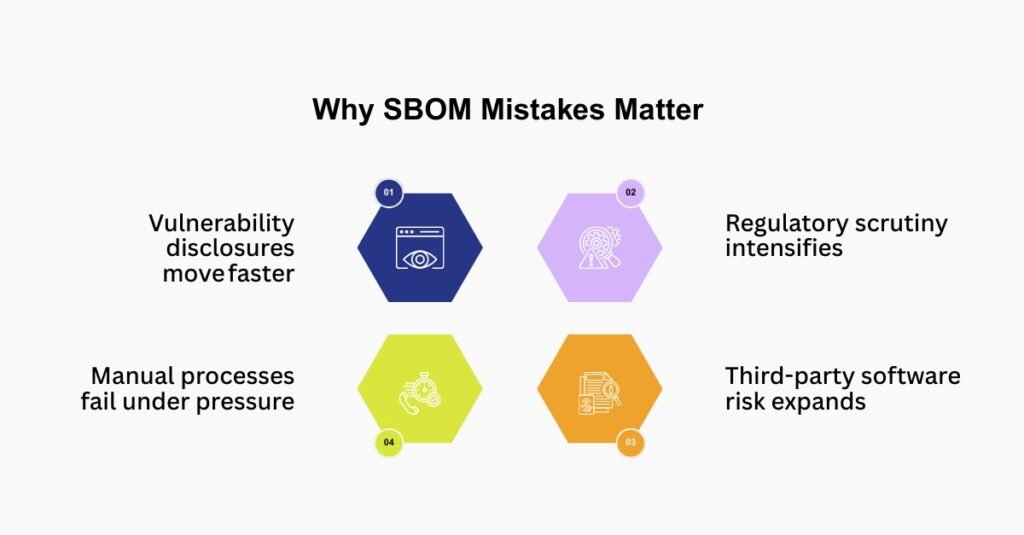
The cost of SBOM mistakes increases as software ecosystems become more connected.
In 2026:
- Vulnerability disclosures move faster
- Regulatory scrutiny intensifies
- Third-party software risk expands
- Manual processes fail under pressure
Companies that repeat these SBOM mistakes will have a hard time responding quickly and confidently during supply chain incidents.
How Mature Organisations Avoid SBOM Pitfalls
Companies that succeed with SBOMs follow a disciplined, operational approach.
Usually, they:
- Automate SBOM generation in CI/CD pipelines
- Validate SBOM accuracy continuously
- Integrate SBOMs with vulnerability response
- Assign clear ownership and governance
- Use SBOMs during real incidents
This approach transforms SBOMs from compliance artifacts into security capabilities.
Next Steps
Companies that want to improve the security of their software supply chains should first figure out which SBOM mistakes are holding them back. Addressing gaps in automation, integration and governance is much more valuable than adding more tools.
CyberNX provides an in-house built SBOM management tool which has an impressive range of features. It provides comprehensive visibility, vulnerability management and multiple deployment models to meet your specific requirements.
Conclusion
In 2026, companies that fix these problems now will be far better positioned to confidently handle software supply chain risk. Security and development teams can respond decisively to new disclosures when they can see vulnerable parts more quickly and accurately.
This is better than scrambling to assemble dependency data under pressure. Mature SBOM programs also help organisations meet the growing security needs of customers, partners and regulators without depending on last-minute manual effort.
It’s not about achieving perfection. It’s about building a strong, operational program that continues to function reliably when there are security incidents, timeline compresses and the cost of delay is the highest.