





Key Takeaways
- Advancements in technology are revolutionizing the decommissioning of aging dams, prioritizing safety and environmental restoration.
- Collaborative efforts between federal agencies and research institutions are leading to innovative solutions for dam removal and ecosystem rehabilitation.
- Real-world examples, such as the Klamath River Renewal Project, demonstrate the effectiveness of these innovative approaches.
Introduction
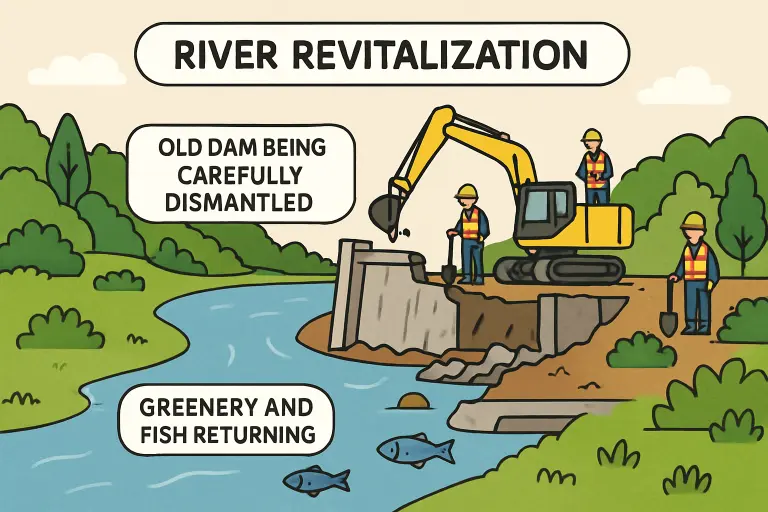
Across the United States, many aging dams pose increasing challenges to structural integrity and environmental management. These structures, originally built to control water flow, generate electricity, or support local economies, may now threaten river ecosystems and community safety. Recent advances in technology and environmental science are transforming the decomissioning of dams into more innovative, safer projects that restore rivers and support ecological recovery. These innovative approaches not only safeguard public infrastructure but also rejuvenate habitats that support native fish and wildlife.
Modern dam removal projects demand a comprehensive balance. On the one hand, they must ensure public and worker safety throughout every phase of decommissioning. On the other hand, they aim to return rivers and wetlands to their natural, free-flowing states, enabling ecosystems to recover from decades of fragmentation. With interdisciplinary teams that include engineers, scientists, government agencies, and communities, the industry now moves toward solutions that support both people and the environment for generations to come.
Technological Innovations in Dam Decommissioning
The modern era of dam decommissioning is characterized by its adoption of high-tech strategies. Notably, engineers and researchers have begun deploying fiber-reinforced polymers (FRPs) alongside a suite of digital tools, including sensors, artificial intelligence, and drones. These technologies provide real-time data on dam conditions and help identify areas requiring reinforcement before safe removal. At the University of Kansas, collaborations with federal agencies are advancing these methods, providing models for managing and dismantling aging infrastructure efficiently without excessive environmental risk. These advances are detailed in publications such as CNN’s investigative reporting on dam removal.
The potential for such technologies is enormous. Sensors embedded into dam structures allow engineers to continuously monitor stress points and water levels, predicting potential failures before they occur. Drones can access hazardous, hard-to-reach sections and provide comprehensive photographic or thermal data, reducing risks for inspectors. Combined, these tools are reshaping how dam decommissioning is approached, ensuring projects can proceed with optimal safety and minimized ecological impact.
Collaborative Efforts for Safe Dam Removal
Many of the greatest successes in dam decommissioning result from multi-stakeholder partnerships. Federal agencies, conservation groups, tribal nations, and local communities are increasingly working together to ensure that dam removals address safety, engineering, regulatory, and environmental concerns at every stage. One standout initiative is spearheaded by The Nature Conservancy, which, with support from the U.S. Fish and Wildlife Service’s Delaware Watershed Conservation Fund, offers hands-on training workshops to equip practitioners with the specialized knowledge required for complex projects. This collaborative approach not only builds capacity but also ensures that local voices help guide the restoration process.
A critical component of these partnerships is transparency and public engagement. Open meetings, community science projects, and outreach can foster trust and gain support for dam removals that result in substantial long-term benefits for regional habitats and economies.
Case Study: The Klamath River Renewal Project
The Klamath River Renewal Project exemplifies what is possible with innovation and collective commitment. Spanning the border of Oregon and California, it is the most significant dam removal and river restoration initiative ever undertaken in the United States. By removing four hydroelectric dams, the project seeks to restore fish passage for salmon and steelhead across more than 400 miles of historic habitat, revitalizing a river system that is culturally and ecologically significant. The collaboration between the Klamath River Renewal Corporation and leading engineering firms demonstrates how science, engineering, and community vision can intersect to resolve some of the country’s most complex water challenges. More on this transformative project can be found in AP News resources.
Environmental Considerations in Dam Decommissioning
Environmental preservation is a guiding priority in all dam decommissioning projects. While structural safety comes first, project teams work to minimize disruption to aquatic and terrestrial life during demolition and riverbed restoration. Innovative solutions such as fish ladders and lifts enable migratory species to bypass barriers, ensuring they remain connected to their ancestral spawning and feeding grounds. These creative adaptations are vital for maintaining biodiversity in river systems, particularly for endangered species sensitive to habitat fragmentation. More details about ecological innovations can be found from organizations like National Geographic.
Additionally, sediment management and water quality monitoring are integral to responsible decommissioning. Project teams often phase the release of water and sediment trapped behind aging dams, carefully controlling flows to avoid downstream flooding or excessive turbidity that could harm fish or aquatic vegetation.
Challenges and Future Directions
Despite the positive momentum, dam decommissioning faces several challenges. Securing adequate funding, navigating a complex regulatory landscape, and ensuring robust scientific assessments of potential impacts can slow or delay key projects. To overcome these barriers, continued investment in research, cross-sector collaboration, and policy reform is necessary. Streamlining permitting processes and expanding public-private partnerships can unlock additional resources and creative solutions, enabling more communities to restore rivers while protecting public safety.
Looking ahead, the future of dam decommissioning is promising. With further advancements in digital technology and a growing commitment to environmental stewardship, even more sustainable and cost-effective practices are expected to become the norm across the field.
Conclusion
Innovative approaches to dam decommissioning are reshaping how the United States restores rivers and maintains community safety. By applying cutting-edge technology, fostering cross-industry collaboration, and prioritizing ecological restoration, today’s projects offer a template for future initiatives worldwide. These changes promise healthier ecosystems, more resilient communities, and a renewed relationship between people and their rivers.