



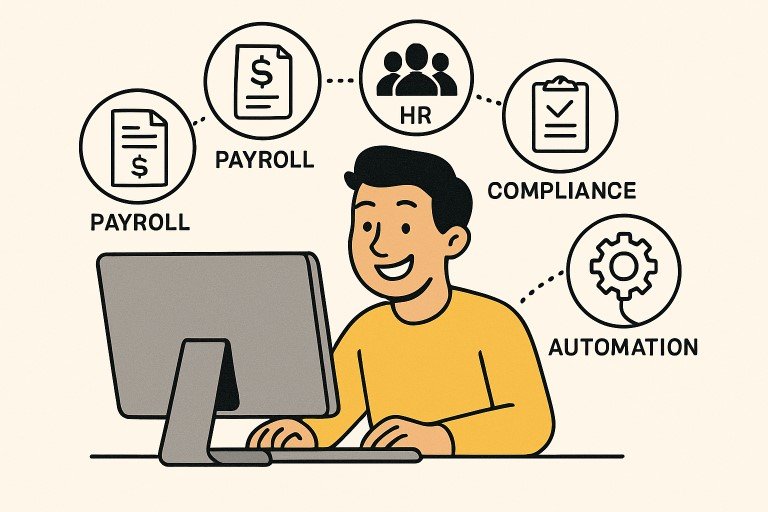
Small businesses face unique and constant challenges when it comes to managing payroll and human resources. Limited personnel, tight budgets, and regulatory complexity often put extra strain on business owners, many of whom tackle multiple roles within their organizations. Manual methods—relying on spreadsheets, hand calculations, or piecemeal solutions for payroll and HR management—are not only time-consuming and inefficient but also often prone to error. These errors can result in costly consequences, including compliance violations, overpayment or underpayment of staff, and even employee dissatisfaction. The rapid adoption of integrated payroll services and HR tools has become a transformative option for small business owners. By uniting essential tasks under a single digital umbrella, these platforms simplify workflow, improve accuracy, and free up vital resources, allowing business owners and managers to dedicate their attention to achieving growth and delivering value to their customers.
Integrated payroll and HR systems do more than automate routine calculations—they create a unified platform where various core administrative processes work together seamlessly. Through automation and centralization, these systems simplify the performance of standard HR functions, automate payroll runs, and streamline benefits administration, while also ensuring compliance with the latest labor regulations. The result is an environment where compliance is simplified, errors are minimized, and employees can quickly and easily access important information independently. With the ever-evolving technology landscape and rapidly changing work environments, implementing these solutions is more crucial than ever. This article examines why these integrated systems have such a profound impact on small businesses—and why now is the ideal time to consider making the switch.
Reducing Administrative Burden
Time is one of the most limited and valuable resources in a small business environment, and the administrative workload can quickly become overwhelming. Instead of spending hours each week or month on manual spreadsheet updates, repeated follow-ups, or double-checking calculations, integrated payroll and HR solutions automate a wide range of daily and periodic tasks. These include everything from clocking employee time and tracking attendance to enrolling in benefits and handling routine employee record-keeping, as well as the intricate work of calculating withholdings and taxes. The built-in automation of these platforms not only accelerates processes but also drastically reduces the likelihood of entering data incorrectly, missing tax deadlines, or losing track of critical HR documentation.
With a streamlined workflow, small business leaders no longer need to operate as their own full-time payroll administrators or HR managers. These saved hours can be redirected toward activities that drive growth, such as strategic planning, building customer relationships, and identifying new market opportunities. By eliminating the friction and risk associated with manual entry and repetitive tasks, an integrated system enables small businesses to operate more efficiently at every level—freeing employees and managers alike to focus on what matters most.
Enhancing Compliance and Accuracy
Staying on top of constantly shifting local, state, and federal employment regulations can be incredibly time-consuming for small businesses, especially for those without in-house legal or HR experts. Even honest mistakes—such as failing to file a new tax form or missing a regulatory update—can result in expensive fines, audits, or lawsuits. Integrated payroll and HR systems are designed to help businesses navigate this complex landscape by providing automatic updates that ensure payroll data, tax calculations, and benefits administration are always in line with current legal standards. This automation significantly reduces the workload for business owners, enabling them to focus on their day-to-day tasks while remaining confident that they comply with all relevant laws.
Critical processes, such as quarterly tax filings, annual reporting, and compliance documentation, can be managed by the software itself, significantly reducing the likelihood of human error and potential liabilities. During an audit or review, having consolidated and up-to-date records on hand can make a world of difference. Moreover, reputable industry resources provide ongoing updates and benchmarks to help businesses stay current with the regulatory environment.
Improving Employee Experience
Today’s workforce expects a high degree of transparency, convenience, and empowerment when it comes to managing their employment information. Modern integrated payroll and HR solutions feature self-service employee portals that provide staff with 24/7 access to their pay stubs, tax forms, direct deposit details, benefits enrollment, paid time-off requests, and more—all from a single, secure dashboard. This means employees no longer need to chase down HR personnel for routine matters, wait for manual approvals, or worry about whether their information is up to date. Instead, they’re entrusted to manage their personal data, check on their payroll status, or make changes to their benefits in real-time, without delays or paperwork bottlenecks.
This level of convenience and access contributes to higher levels of employee satisfaction and morale. By making information readily available and user-friendly, businesses demonstrate that they trust and respect their employees, which in turn improves retention rates and fosters a supportive workplace culture. The reduction in repetitive HR inquiries also lightens the administrative staff’s load, further increasing overall efficiency for the company.
Facilitating Data-Driven Decisions
In the competitive world of small business management, access to reliable, real-time workforce data is indispensable. Integrated systems don’t just store information—they aggregate and analyze it, providing business leaders with comprehensive reports on metrics such as labor costs, overtime, absenteeism, employee turnover, and more. These actionable insights enable managers to uncover hidden trends, identify areas for improvement, and forecast future payroll expenses with greater accuracy. Armed with up-to-the-minute reporting, business owners are better equipped to allocate resources strategically, respond to workforce demands, and pivot rapidly as market conditions change. This data-driven approach is essential for maintaining a competitive edge, particularly for growing businesses that must respond rapidly to new opportunities or challenges.
Ensuring Scalability and Flexibility
Ambitious small businesses must always keep growth in mind, anticipating not just more employees but also new HR and payroll complexities that result from expansion. As companies grow, they may need to recruit for new roles, onboard contractors alongside full-time staff, adapt to labor laws in new jurisdictions, and offer an expanded suite of benefits. Integrated systems are purpose-built to accommodate this growth, scaling easily as new features, users, and integrations become necessary. Instead of requiring frequent manual migrations, switching platforms, or enduring lengthy downtimes for system upgrades, adaptive payroll and HR solutions adjust seamlessly to increased business demands.
This flexibility ensures that technology never becomes a bottleneck to progress. Instead, with integrations for accounting, scheduling, and even recruiting software, today’s payroll and HR platforms help support expansion efforts and keep businesses agile, no matter how rapidly they grow or change.
Strengthening Data Security
Payroll and HR data represent some of the most sensitive records any business holds, containing not only financial information but also personal data that can be devastating if exposed. Security breaches involving this data may result in significant financial losses, regulatory penalties, and irreparable reputational damage. Modern integrated HR and payroll tools are designed from the ground up with enterprise-grade security in mind, combining technologies like advanced encryption, multi-factor authentication, detailed user permissions, and comprehensive audit trails to safeguard both employee and company data at all times.
By employing these robust security measures, businesses make it extremely difficult for unauthorized users or hackers to gain access to confidential information. In turn, employees feel assured that their personal and financial details are safe—a benefit that further strengthens trust and loyalty within the organization.
Conclusion
Adopting integrated payroll and HR systems offers unmatched advantages for small businesses seeking to enhance efficiency, mitigate operational risk, and ensure compliance, while fostering a positive employee experience. As these systems become increasingly accessible and sophisticated, the advantages they once reserved for large enterprises are now widely available to all businesses, regardless of their size. By leveraging these powerful tools, small business owners can spend less time managing paperwork and more time focusing on sustainable growth, innovation, and building a strong organizational culture in today’s dynamic and competitive landscape.